My Story
How I Got Here
I was born in Midland, Texas, but I didn't grow up in any one place. Kingwood, Pecan Grove, The Woodlands, Baton Rouge—and then overseas. Balikpapan, Indonesia. Karachi, Pakistan. I was a third culture kid, the kind who learns early that the world is bigger than wherever you happen to be standing, and that every place has its own way of making sense of itself.
Along the way I became a trained biologist who studied microbiology and forensics. I got my pilot's license. Became a PADI Rescue Diver. Licensed radio operator. Certified in oil rig blowout response. Became a blacksmith. An ordained minister. I have always been the kind of person who needs to understand how things work—and then learn how to do them myself.
The biology was Sam Houston State University—a B.S. in biology, a minor in criminal justice. From 2009 to 2011 I worked in Dr. Aaron Lynne's lab on the metagenomics of human decomposition, research carried out at STAFS, the university's forensic science facility. I was also the lead teaching assistant for microbiology: running lab prep, directing the other teaching assistants, writing curriculum and test material, and lecturing when the professor couldn't. Two peer-reviewed papers and a book chapter came out of that work. One of the papers started as a lab problem—a reagent recipe nobody could follow—and became a protocol that other labs still use. The publications are here.
Before the lab I taught emergency medicine—CPR, ACLS, and EMT at every level—and worked as a skills examiner for the National Registry of EMTs. After it, I went into oil and gas. From 2013 to 2015 I was a drilling engineer, and then a drilling and production engineer, at Argent Energy Trust in Houston: engineering and operations across the company's Kansas assets, and wells in the Eagle Ford, the Austin Chalk, and deep South Texas. That is where the blowout-response certification stopped being a curiosity and became the job.
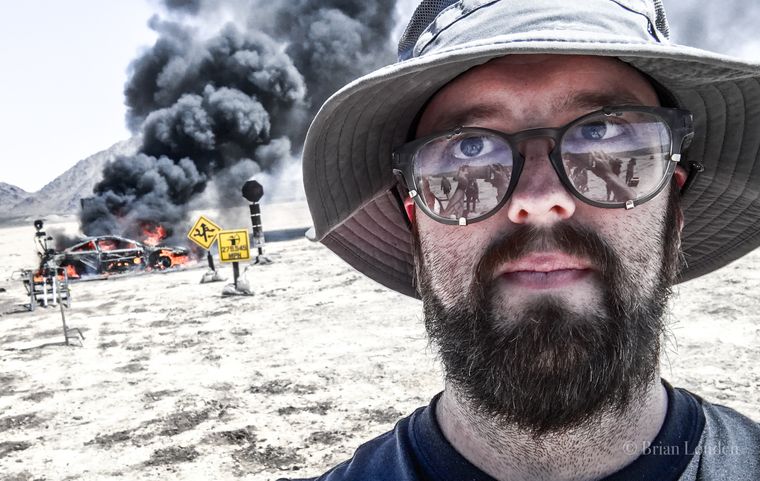
In 2017, I won MythBusters: The Search on the Science Channel—a national competition—and went on to host a season of the multi-Emmy nominated television show MythBusters. It was a dream. National television, real science, genuine curiosity rewarded at scale. It also taught me that the most interesting work happens when you own the platform, not when you rent someone else's.
My wife had already been on St. Croix for sixteen years when we met. She ran the botanical garden at St. George Village. One day she needed a blacksmith—and had no idea where to find one on a Caribbean island. She mentioned it to friends at the marine shop, which also happened to be a bar, and they happened to know me. It was one of my random skillsets. A few months later I reached out about the opportunity, but she was busy—with Dan Aykroyd, at a play—and had to call me back. When she did, we talked for hours. That was the beginning of what we call our "endless conversation." It hasn't stopped.
My social media presence was always personal sharing—until my girlfriend died. I started posting on TikTok sharing the raw, deep truth of that experience. I read the letters I'd written to her in the days after she passed, out loud, with every emotion, for everyone to hear. It built a community I never expected. People found something real in it.
During that time, I found myself working at La Reine fish market on St. Croix, selling spearfishing supplies and renting scuba tanks to local fishermen. That's where I first started hearing all the island gossip—the real kind, from the people who live it. I also started sharing more about my own life on St. Croix. Not everyone's experience, just mine. My growing appreciation for the people, the culture, and the history of the place I'd chosen to call home.
As I left the fish market behind, I was gaining momentum online for sharing culture and history—and digging deeper than what the modern internet provided. More and more locals began to follow. I started to develop a perspective that matters to me: part of the community but not a local. On the inside, but not from the inside. I learned about the Revised Organic Act of 1954 and its role as the root of so much territorial dysfunction. I studied the associations of U.S. territories to mainland America. I went back to the Taino, to Salt River Bay in 1493, to the beginning. And I shared it all.
Your islands. Your news. Our reporting.
Then one night, poking around in forums in the middle of the night, just trying to answer people's questions about the USVI and help where I could, I saw a notice about Kmart. The long-forgotten institution had two stores on St. Croix when I moved here. One had already closed. The other was about to. This was the only full-sized department store on the island. The anchor store of the major shopping center. On an island where goods are hard to come by, prices are high, variety is low, and shipping is prohibitive and slow. Losing it was going to be a major blow.
So I simply told people.
And I have been simply telling people ever since. Keeping the news to the facts, but taking those facts deeper and further back in history than anyone else. The way only a trained biologist who studied microbiology and forensics, an expert researcher, and a MythBusters-level communicator could.
So I started building.
VI Update became investigative video journalism with a dedicated following across Facebook and TikTok. I write every script, film every segment, and make every editorial decision. But the journalism was only the start. I saw the same gaps everywhere—in civic tools, in cultural documentation, in how the islands' own living culture was represented on the internet—and I started building solutions for all of them. Civic directories that didn't exist. Behavioral action campaigns. An encyclopedia of 60-plus microsites documenting the food, music, language, heroes, history, and identity of these islands. A bias-decoding national news publication. An AI methodology transparency page. Family tools I share with anyone who wants them.
Today I operate a digital ecosystem of 15-plus web properties and 170-plus domains, spanning journalism, civic engagement, government accountability, living culture, and publishing. Every one of them is free. Every one of them is built and operated by me alone. No staff. No investors. No advertisers. Just the work.
The U.S. Virgin Islands is a territory of roughly 87,000 people spread across three islands. Everyone knows everyone. The governor appoints agency heads, the attorney general, and territorial judges—creating a system where the subjects of investigative reporting may have direct influence over the courts where disputes would be heard.
The territorial public records law has no response deadlines, a $100 penalty for violations, and no meaningful enforcement mechanism. The USVI government received the Society of Professional Journalists' Black Hole Award for what they called "bald and breathtaking contempt of the public's right to know." The Virgin Islands Daily News won a Pulitzer Prize for Public Service in 1995 for a crime investigation series—and the reporter on that story received threats severe enough to relocate his family to the mainland.
That environment has not improved. Sources are reluctant to speak because most residents work for the government or are connected to someone who does. Attorneys who represent journalists risk alienating government clients. I live in this environment and report from inside it, on governors, agencies, and powerful interests. People bring me things they don't bring to anyone else because they've watched me handle sensitive information responsibly—and watched me not back down.